

22/09/2026
The prospectus, five years on from Lord Hill: what does it look like now?
The past five years have seen a shift from a relatively prescriptive UK prospectus/listing regime towards a more flexible, disclosure-focused framework, with the most impactful prospectus-specific changes concentrated in 2024 - 2026.
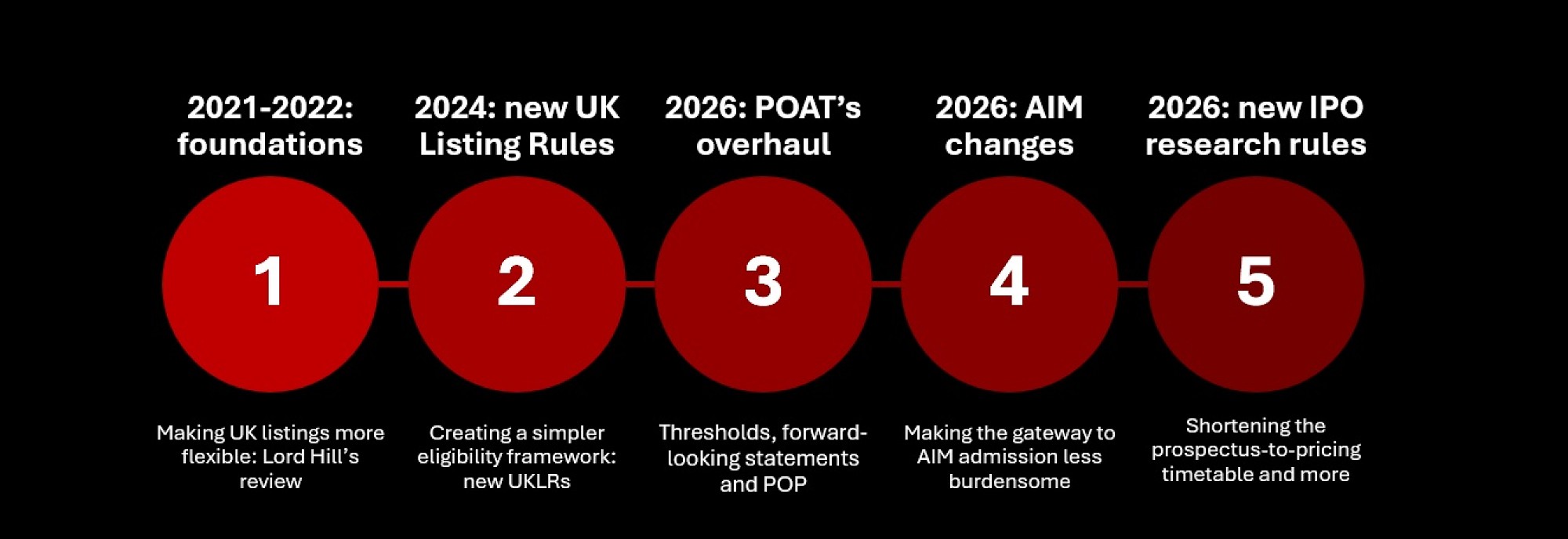
Our article explores the direction of travel over five key stages - in particular, explaining last month’s changes which further significantly affect the prospectus.
Stage 1: The 2021-2022 foundations - making UK listings more flexible
The reforms initiated by Lord Hill's review were primarily changes to the listing regime, rather than the prospectus itself, but they materially affected the IPO framework. Dual-class shares became more permissible, allowing founder-led and other qualifying companies to retain enhanced voting rights while obtaining a premium listing. The minimum free-float requirement also fell from 25% to 10%, making it easier for companies and existing shareholders to retain larger stakes after an IPO.
These reforms were intended to make London more attractive to high-growth, technology and founder-controlled businesses, and in the process establishing a broader policy direction: reduce structural come-to-market barriers while giving issuers greater flexibility. This, in turn, paved the way for a review of the prospectus.
Stage 2. New UK Listing Rules - a simpler eligibility framework
The Financial Conduct Authority's new UK Listing Rules (UKLRs), effective from 29th July 2024, represented the biggest overhaul of the listing regime in more than 30 years. Although again not themselves a wholesale rewrite of the prospectus rules, they further and significantly changed the environment in which prospectuses are produced.
The previous premium/standard listing structure was replaced by a single ESCC category for commercial companies. At the same time, the FCA removed historic requirements for a three-year financial track-record, historical financial statements and a "clean" working-capital statement as eligibility conditions.
These rules moved significant transactions away from a shareholder approval/circular process towards disclosure, reducing the amount of historical financial information and transaction documentation required around an IPO.
Stage 3: POAT - the major Prospectus overhaul
The most important direct change to the prospectus framework came with the Public Offers and Admissions to Trading (POAT) regime, effective 19th January 2026.
For secondary offerings, the biggest change was the raising of the threshold below which a prospectus is generally not required from 20% to 75% of issued share capital, enabling issuers to undertake a substantially larger follow-on equity raise without automatically having to produce a prospectus.
At the same time, POAT introduced a special regime for protected forward-looking statements: where such statements are clearly identified in the prospectus, liability is based on a higher recklessness/dishonesty standard, rather than purely on negligence.
This change intended to make companies more comfortable providing meaningful forward-looking information without exposing themselves to the same level of liability associated with ordinary prospectus statements.
Equally, POAT reduced the minimum period between making a prospectus public and admission to trading from six to three working days, making it easier to run retail and institutional offerings concurrently and shortens the overall IPO timetable.
POAT also created a new Public Offer Platform (POP) exemption. Subject to the relevant conditions, companies could make public offers of securities exceeding £5m to UK retail investors without an FCA-approved prospectus, provided an FCA-authorised POP operator facilitates the offer. SpaceX’s 12th June 2026 IPO became the first to take advantage of this facility.
For all other Main Market IPOs, with some exceptions, the prospectus is still a requirement.
Stage 4: AIM admission documents become less burdensome
The 5th August 2026 AIM reforms were particularly relevant to the prospectus/ admission-document process, reducing the length, cost and complexity of preparing an AIM admission document.
- Working-capital statements were removed and replaced with targeted disclosure about material capital resources, commitments, liabilities and expected fundraising needs over 12 months.
- UK GAAP (FRS 102) is now an accepted accounting standard, reducing the need for private companies to convert accounts to IFRS before admission.
- Incorporation by reference is permitted for historical financial information which is readily available to investors.
- The LSE intends to conduct a further consultation aimed at simplifying AIM admission documents.
Stage 5. IPO research rules shorten the prospectus-to-pricing timetable
The COBS reforms also took effect on 5th August 2026 and have an important practical impact on IPO prospectuses, reducing market exposure and execution risk for issuers. The seven-day waiting period between publication of an FCA-approved prospectus/registration document and connected IPO research was effectively removed, allowing the prospectus and connected research can be published simultaneously. At the same time, the requirement for firms publishing connected IPO research to provide the same information to unconnected analysts was also removed.
What does this mean for issuers?
The direction of travel is clear: the UK has moved away from a "prospectus for every significant capital markets event" model towards a more proportionate, disclosure-based regime.
The latest AIM reforms and COBS changes reinforce the same earlier philosophy: reduce unnecessary process and cost, shorten transaction timetables and give issuers greater flexibility, while retaining targeted disclosure and investor protections.
Of note, the reforms are not finished. The FCA is still considering further changes to registration documents, analyst/issuer interactions, closed-ended investment funds, DTRs and working-capital guidance, while the LSE intends to consult further on simplifying AIM admission documents.
So while there are fewer occasions on which a prospectus is necessary, and while the process around its production has become significantly simpler and the prospectus itself shorter, there will still be a requirement for a disclosure document providing a single point of truth.
Other recent news
22/09/2026
The prospectus, five years on from Lord Hill: what does it look …

11/09/2026
Engineering the best outcome: B&C assists with £345m acquisition…

03/09/2026
B&C helps with the £404m acquisition of Picton Property Income b…

24/08/2026